I have been collecting marbles since 1975. For most of those fifty years, my method for sizing one has been to hold it up, squint at it, and say a number out loud with more confidence than I had earned.
That works fine when you are looking at one marble. It falls apart when you are looking at four hundred.
A few months ago I was working through a jar I had bought at an estate sale, sorting for a run of listings. Somewhere in the middle of it I caught myself doing what I always do: pick one up, hold it next to one I had already sized, decide it was about the same, and drop it in the pile. Then I did it again with the next one. By marble number sixty I was sizing against a marble I had sized against a marble I had sized against a guess.
How I had been doing it
Three tools, all of them slightly wrong for the job.
A drafting circle template, the plastic sheet with the printed circles, which I have had since art school. Quick, but you are eyeballing a sphere against a flat printed circle from an angle, and you are always a little generous with yourself.
Digital calipers, accurate to the thousandth, which I do not enjoy putting anywhere near a good handmade. Steel jaws and old glass are not friends. They are also slow. You open, seat, read, write, repeat, and after twenty marbles you stop being careful.
And squinting, which is free and exactly as reliable as it sounds.
Why the number actually matters
If size were only a blank to fill in on a listing, I would not have bothered. But size is one of the few things about a marble that is genuinely objective, and it does real work.
It narrows the maker. Factories ran their glass through sieves, and the sizes they produced cluster in ways that are still visible in what survives. Size alone will not name the maker, but it will tell you which makers to stop considering, and on a common marble that is most of the battle.
It sets the grade conversation. A 3/4 example of something usually catalogued at 5/8 is a different marble, and priced like one.
And it keeps you honest with buyers. “Approximately 5/8” in a listing is a phrase that means the seller did not measure. I have written it. I am not proud of it.
The fat 5/8 problem
Here is the thing that finally pushed me into making something.
There is a real and annoying gap between 5/8 and 11/16. A lot of vintage machine made marbles land right in it. They are too big to honestly call 5/8 and too small to call 11/16, and so for years I called them a fat 5/8, which is not a size, it is an apology.
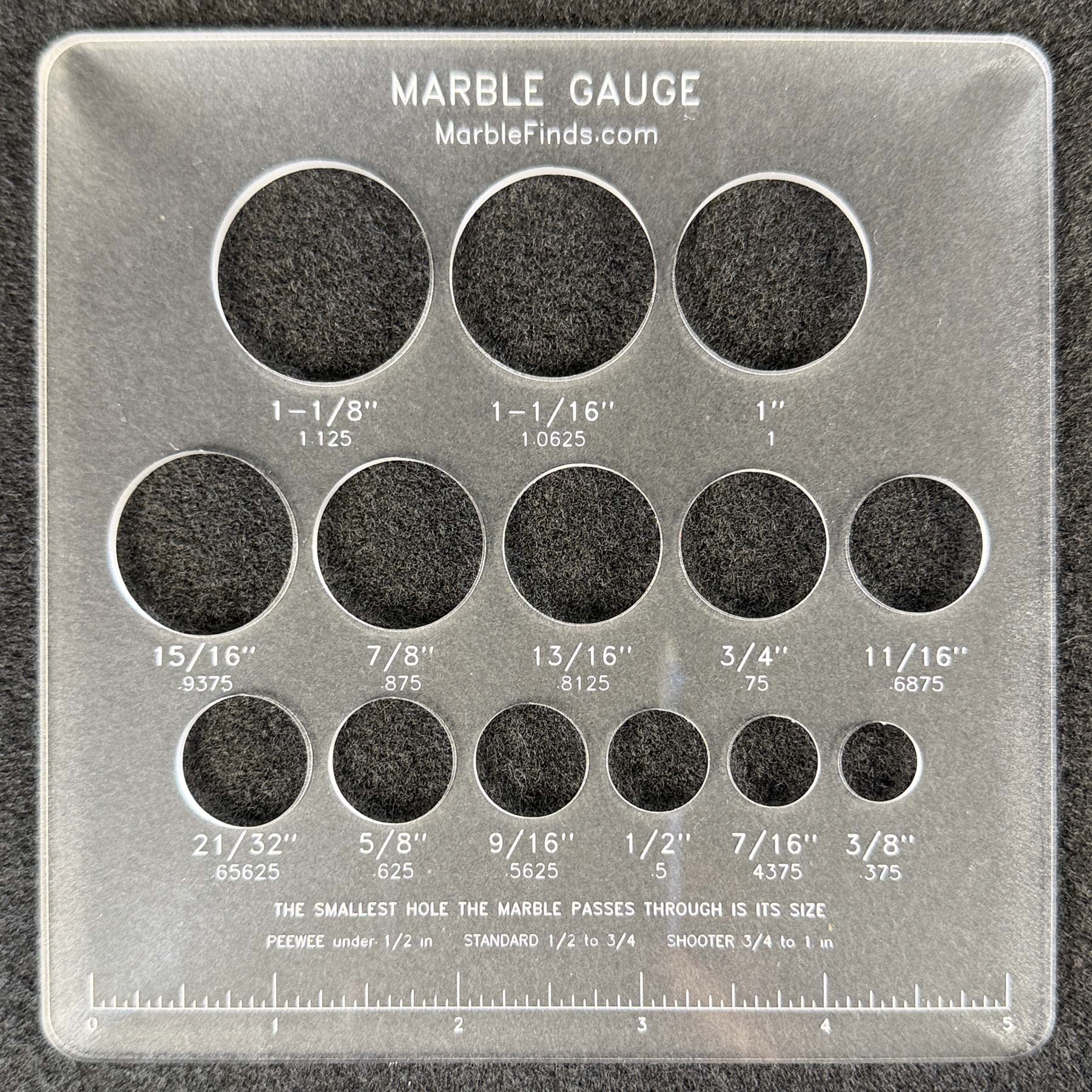
That gap is 21/32. It has a decimal, .65625, and it exists whether or not anybody puts it on a chart. I wanted a hole for it.
Making the thing
The idea is not original and I want to be clear about that. People have been drilling boards and building sorting trays for as long as there have been marbles to sort. Factories used sieves. What I wanted was a tidy version: one flat piece, every size I actually use, labeled in fraction and decimal, small enough to sit next to the tray instead of in a drawer.
It took three versions to get there. The first two taught me things I did not expect to have to learn, and I will spare you the details except to say that the hole in a gauge and the number printed under it are not automatically the same thing, and that getting them to agree took more measuring than the whole rest of the project combined.
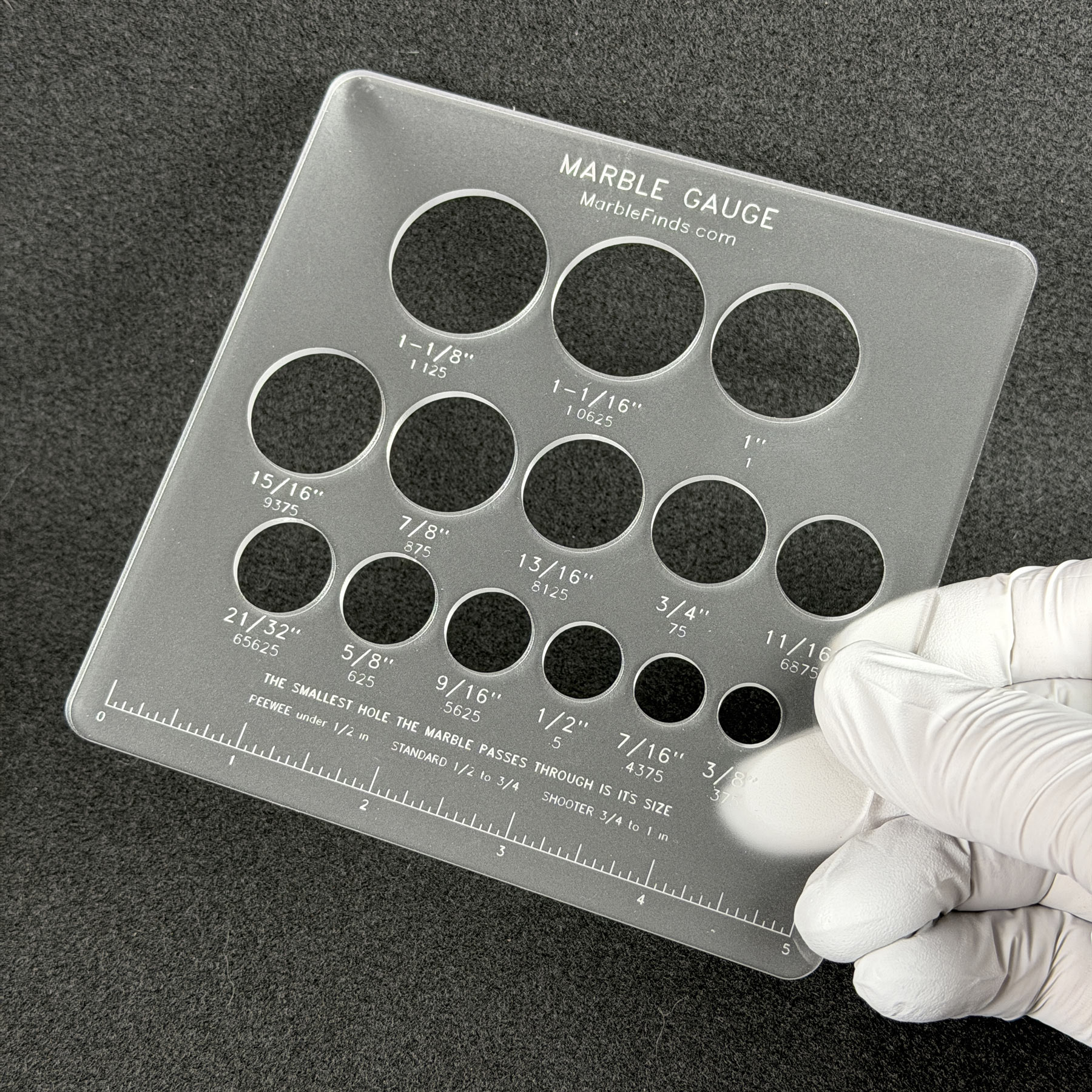
What I ended up with is fourteen holes, 3/8 up through 1-1/8, in a five and a half inch square of clear acrylic with a frosted back. The engraving is on the back and reads through the front, so it cannot wear off with handling. Which matters, because the whole point is that this thing gets picked up every day. I call it the Marble Gauge and the first run is available if you want one.
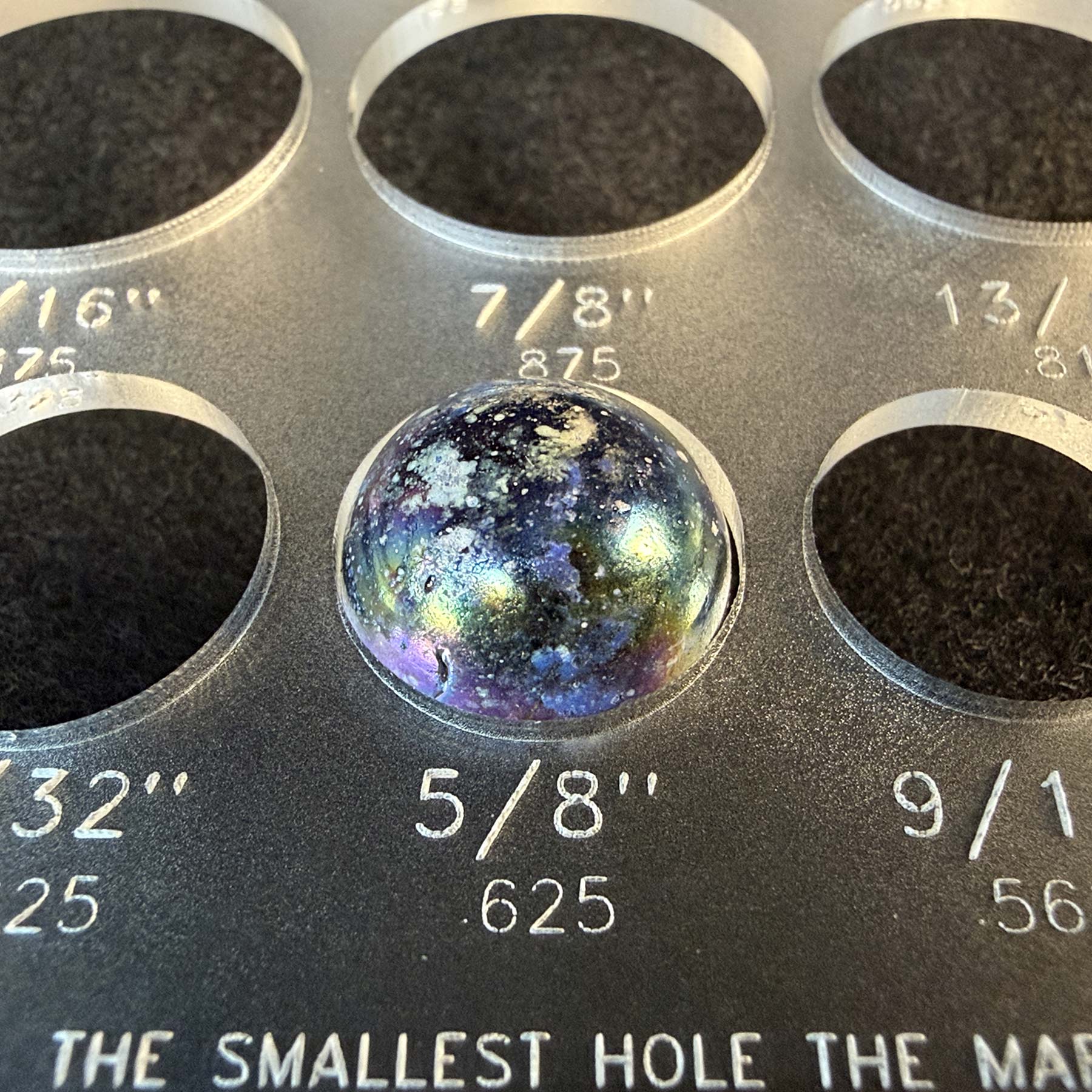
The rule is the simplest part. The smallest hole the marble passes through is its size.
What it is not
It is not a substitute for calipers. If you need a reading to the thousandth, for a rare piece or a dispute or a reference photo, get the calipers out. This will not do that and was never trying to.
What it does is the other ninety percent: working through a lot, sorting a jar, grading a group, writing listings that are accurate instead of approximate. It is the thing I reach for first, and the calipers stay in the drawer until something unusual shows up.
The next run
I had a few dozen made. I am using some of them and I would rather the rest went to people who actually sort marbles than sat in a box on my shelf.
There will be a second run eventually and I would rather fix things in it than defend the first one. So if you look at that hole set and see something missing, tell me. Should the steps be finer at the small end, where a sixteenth is a bigger proportional jump? Is there a size you use constantly that I left off? Is 1-1/8 the right place to stop?
Decades in, I am still finding out that the things I was sure about were just approximate! See it here.