Clambroths
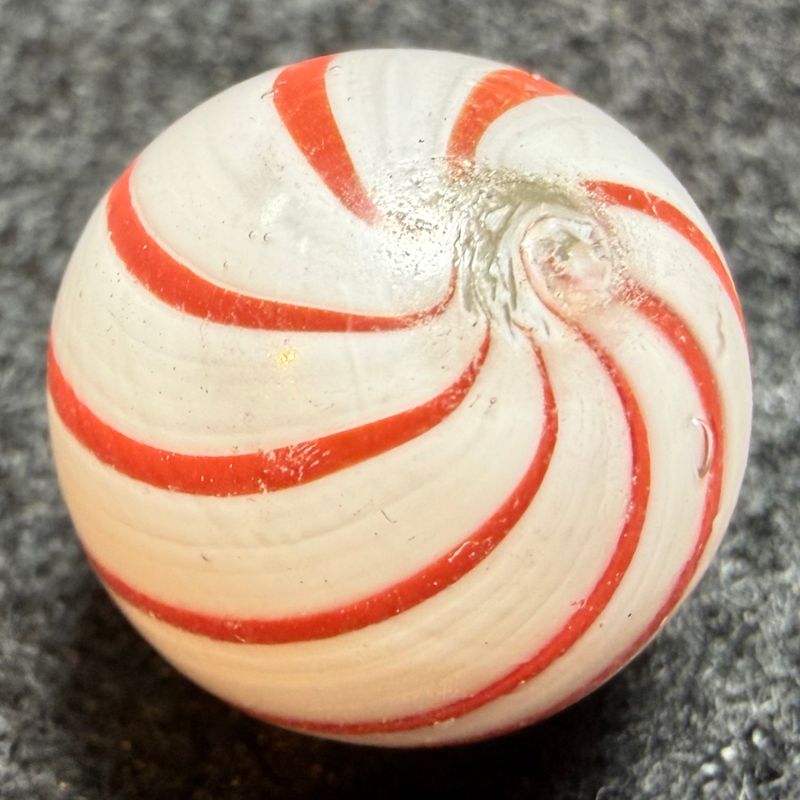
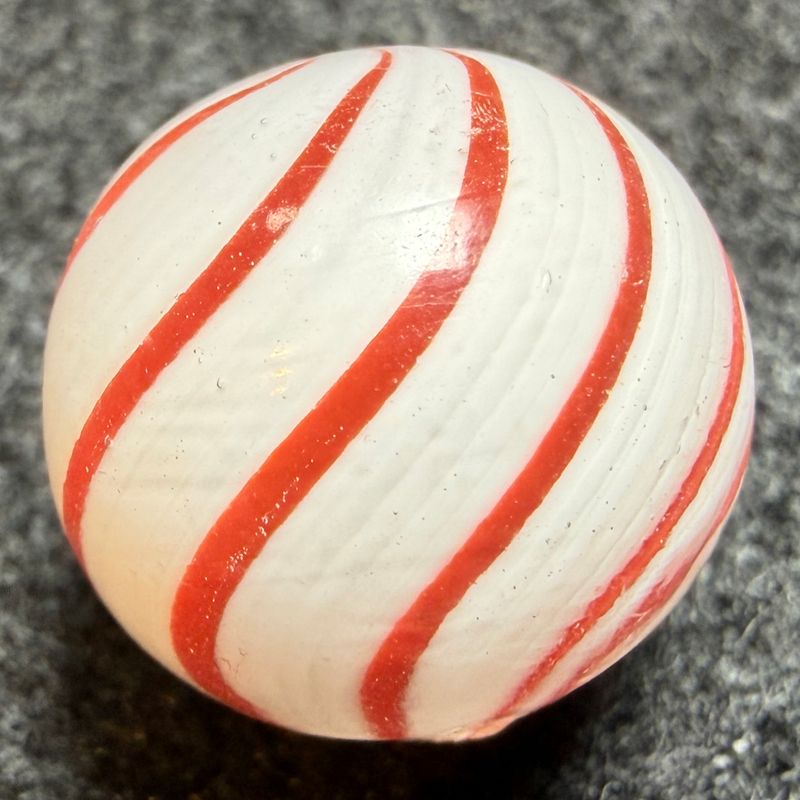
Clambroth marbles are among the earliest German handmade glass marbles produced, dating primarily from the 1850s through the 1880s. The name comes from the milky white base glass, which glassworkers of the era apparently felt resembled the pale, cloudy liquid from cooked clams.
The defining characteristic is a series of evenly spaced colored lines running across the surface of an opaque or semi-opaque base glass. Six to eighteen lines is the typical range. Common line colors are red, pink, blue, and green. Two or more line colors on a single marble are less common and more desirable.
The white base is standard. Non-white bases, particularly black, blue, or grey, are uncommon and carry a premium.
Two specialty variants stand apart. Caged Clambroths have 30 or more closely packed lines covering most of the surface. Cased Clambroths are built differently, with an inner core of clear glass and an outer layer of clear glass sealing the lines inside. Both are scarce.
Clambroths were not a commercial success in their day. Many were made with a soft, brittle glass that chipped too easily under normal play. Although, higher quality examples were produced using harder, more durable glass. Fewer were made than most other German handmade types to begin with. Survivors in mint are uncommon.